GPS Time vs UTC vs IST: Why Timing Equals Positioning
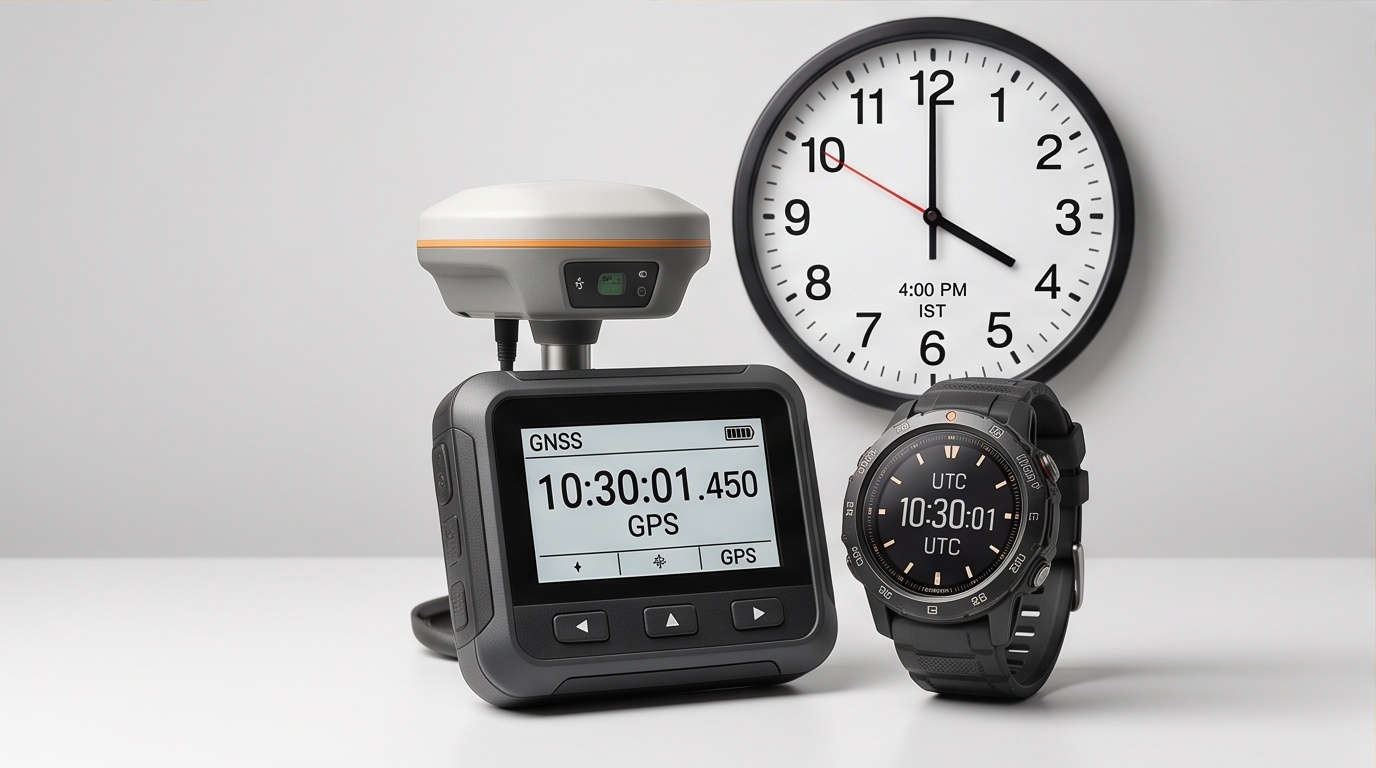
Live GPS Time vs UTC vs IST Comparison Tool
Nanosecond Clock Error to Positioning Error Calculator
| Timing Error | Positioning Error | Real-World Scale |
|---|---|---|
| 1 nanosecond (1 ns) | 0.2998 m (~30 cm) | about one long walking stride |
| 1 microsecond (1 µs) | 299.79 m (~300 m) | about three football fields end to end |
| 1 millisecond (1 ms) | 299,792 m (~300 km) | a multi-hour highway drive |
RINEX (Receiver Independent Exchange Format) observation files stamp every epoch with a calendar date and time, down to fractional seconds, drawn from GPS time in most current format versions, though some receivers and older RINEX versions log UTC-based time instead. Either way, that timestamp comes straight from the receiver's own clock discipline, so a receiver that tracks the satellite time signal poorly produces epoch timestamps that drift before the position solution itself shows any sign of trouble.
A GPS receiver does not measure distance. It measures time, in billionths of a second, and turns that into a coordinate.
Why GPS Time Turns Into Position, Not the Other Way Around
GPS time is the reason a receiver can turn a radio signal into a coordinate. It never measures distance directly, it measures how long a satellite signal took to arrive and multiplies that travel time by the speed of light. The receiver on the ground and the satellite 20,000 km overhead are effectively sharing one stopwatch. Drift that stopwatch by a few nanoseconds and the computed range shifts by tens of centimetres, an error that lands directly in the coordinates from every DGPS RTK survey.
GPS Time, Leap Seconds and Why Receiver Clocks Matter on Site
That is why satellites carry atomic clocks stable to a few parts in a trillion, and why receiver firmware applies relativistic corrections for time dilation and gravitational frequency shift, adjustments a wristwatch never needs. It is also why GPS time carries no leap seconds. UTC bends to track Earth's slightly irregular rotation, GPS time just counts forward from its 1980 epoch, and the gap between them grows only when a leap second is added to UTC. For anyone running topography or GNSS control work, the receiver's clock discipline matters as much as its antenna placement.