Digital vs Physical Bubble Level Precision Test
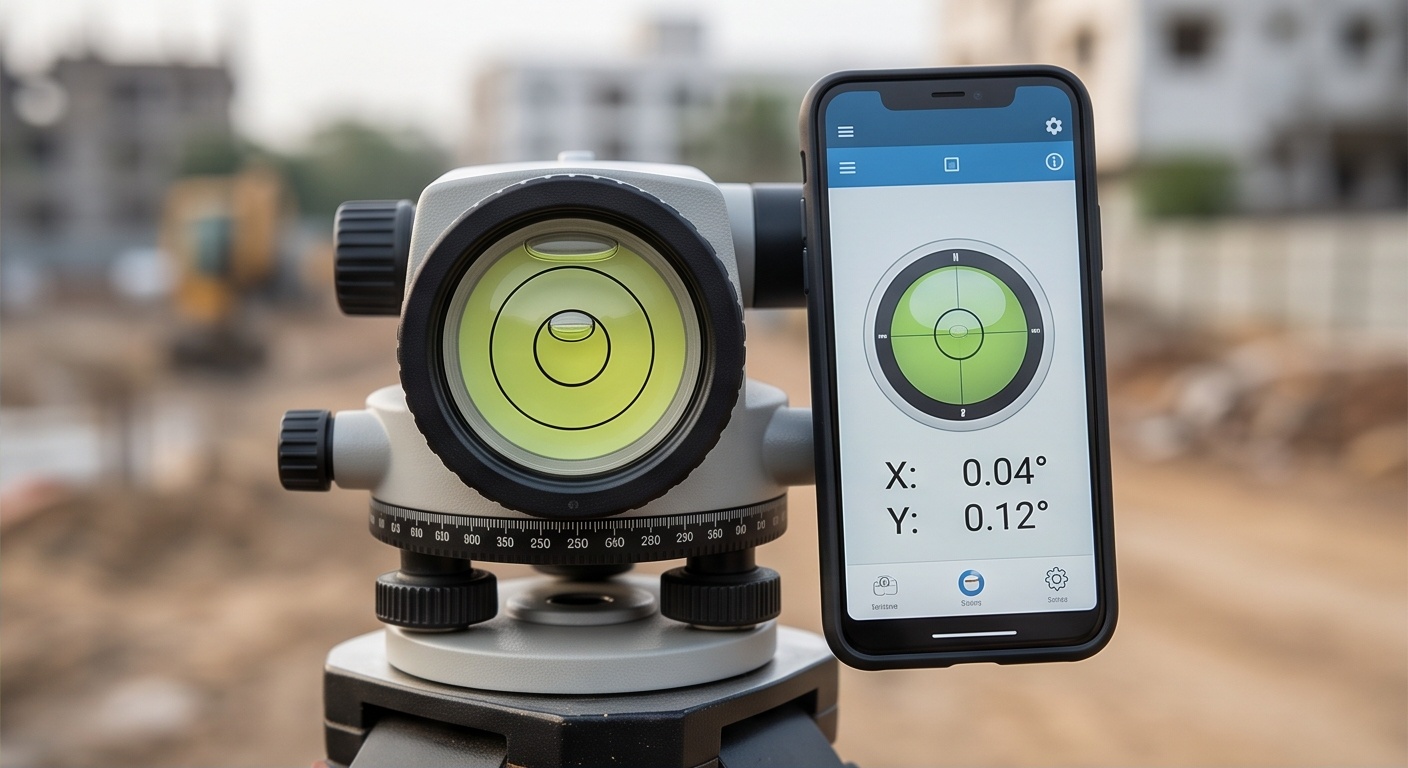
A circular vial that looks dead center on a total station can still sit tilted enough to shift a stakeout point by several millimetres over a hundred metre shot, and almost nobody checks that gap against the tilt sensor already sitting in their pocket. This bubble level precision test puts both side by side, live, so the difference stops being a line in a training manual and becomes a number you can watch move on screen.
Test Bubble Level Precision: Digital Tilt Sensor vs Physical Vial
Tap Enable Motion Sensors if you are on a phone, or drag the slider if you are on a desktop or the browser blocks sensor access. Both drive the same bubble graphic and the same compensator check below.
Field technicians typically need about 30 to 40 seconds of fluid settling time to confidently read a 2mm-division shift on a plate vial, versus roughly the time needed to glance at a steady digital number. Both figures are commonly-cited field observations, not a single lab measurement.
Compensator Range Status (reacts to the tilt above)
Total station compensators (liquid-damped or electronic) only correct tilt within their own mechanical or optical swing, commonly published across manufacturer manuals as roughly ±3 to ±6 arcminutes (about 0.05° to 0.1°). This demo uses ±5.0′ (0.0833°) as one representative mid-range limit to illustrate the cutoff live; check your own instrument's manual for its exact figure.
Digital Bubble vs Physical Bubble at a Glance
| Attribute | Physical Plate Vial | Digital Phone Sensor |
|---|---|---|
| Typical resolution | 8″ to 30″ per 2mm division (0.0022° to 0.0083°) | ≈0.1° (about 360″), varies by device and calibration |
| Settle / read time | Commonly 30 to 40 seconds of fluid settling | Near-instant numeric readout once the hand is still |
| Drift and calibration | Needs periodic vial adjustment, stable once set | Accelerometer bias drifts with temperature and handling |
| Legal traceability | Accepted for cadastral and construction control work | No calibration standard, not accepted as instrument of record |
| Best use on site | Control leveling, stakeout, construction layout | Rough reconnaissance, quick platform checks, training |
Tripod Settlement: The Drift Nobody Watches
- Set up and precisely level the instrument over the mark, using the circular vial for coarse leveling and the plate vial or electronic tilt display for the fine level.
- Take the initial reading and log it, whether that is a backsight angle, a distance, or a benchmark elevation.
- Let the crew continue other work for roughly 10 to 15 minutes rather than moving the instrument straight away.
- Before the next critical shot, glance at the bubble or the electronic tilt display again instead of assuming it held its position.
- If drift shows up, relevel before proceeding. On soft, wet, or recently disturbed ground, switch to tripod shoes or plates that spread the leg load, and shorten the interval between rechecks.
A dual-axis compensator, liquid-damped or electronic, only has so much physical swing to correct for residual tilt, roughly the same 3 to 6 arcminutes that manuals quote as its working range. Push the setup past that swing and the correction mechanism runs out of travel, there is nothing left to compensate with. Rather than silently logging a bad angle, the instrument holds the shot and forces a relevel, which is exactly the behaviour protecting the reading rather than a fault.
Terms Used on This Page
Why Bubble Level Precision Still Decides Stakeout Accuracy
The number that matters on site is not the tilt angle by itself, it is what that angle does to a shot over distance. A residual tilt of 0.05°, comfortably inside the compensator's stated range on most instruments, still produces a vertical error of about 43.6 mm at 50 metres once you work out D × tan(θ) plainly, and that error roughly doubles again if the shot runs to 100 metres. A bubble that looks centered at a glance is not the same thing as a bubble that is actually centered, and this is exactly what most crews never stop to test.
On a construction survey site where formwork tolerances run in single digit millimetres, an uncompensated tilt like that is not a rounding footnote, it is the difference between a slab or a footing that clears inspection and one that gets flagged for rework. The same margin decides whether a stakeout point for a column base or a pipe invert lands where the drawing says it should. Crews who treat the bubble as a formality rather than a checkpoint are usually the ones re-running a line the next morning.
Why Your Phone Is Not a Substitute for a Calibrated Total Station
A modern smartphone's accelerometer and gyroscope are genuinely capable sensors, accurate enough to keep a photo level or steady a game character. The stated resolution on most consumer devices lands around 0.1°, roughly 360 arcseconds. Set that beside a standard plate vial's 30 arcseconds per 2mm division and the phone is already about twelve times coarser. Compare it against a high-precision 8 arcsecond vial and the gap widens to more than forty five times. Neither figure is hidden, both come straight from published manuals and basic trigonometry, but almost nobody puts them side by side and watches the gap move in real time the way the tool above lets you do.
Resolution is only half the story. Phone sensors drift with temperature, lose calibration after a drop, and carry no certificate that a construction QA team or a land record office will accept. That is exactly why this comparison exists as a demonstration rather than a recommendation: use a phone to get a fast read on whether a rough platform is close to level before hauling equipment up, never as the instrument of record for stakeout, control leveling, or anything that ends up on an approved drawing.
How Total Station Compensators Decide What to Reject
A dual-axis compensator only has so much physical travel to correct for residual tilt. That travel is the same 3 to 6 arcminute range most manuals quote as the instrument's operating limit. Push the setup past it and the correction mechanism runs out of room; there is nothing left to compensate with, so the instrument holds the shot instead of logging a silently bad angle. This is the same physical constraint that governs every site leveling workflow on a project, not a software choice a firmware update could remove.
None of this makes a phone useless on site. It is a fast way to sanity check a tripod position or flag an obviously unstable platform before real equipment goes up. What it cannot do is replace the plate vial and compensator doing the actual work of holding a shot inside tolerance. If your next job needs a total station leveled, calibrated, and run by a crew that treats a centred bubble as a checkpoint and not a formality, reach out below.