Pacing vs Tape vs EDM: Calibrate Your Own Distance Measurement Accuracy
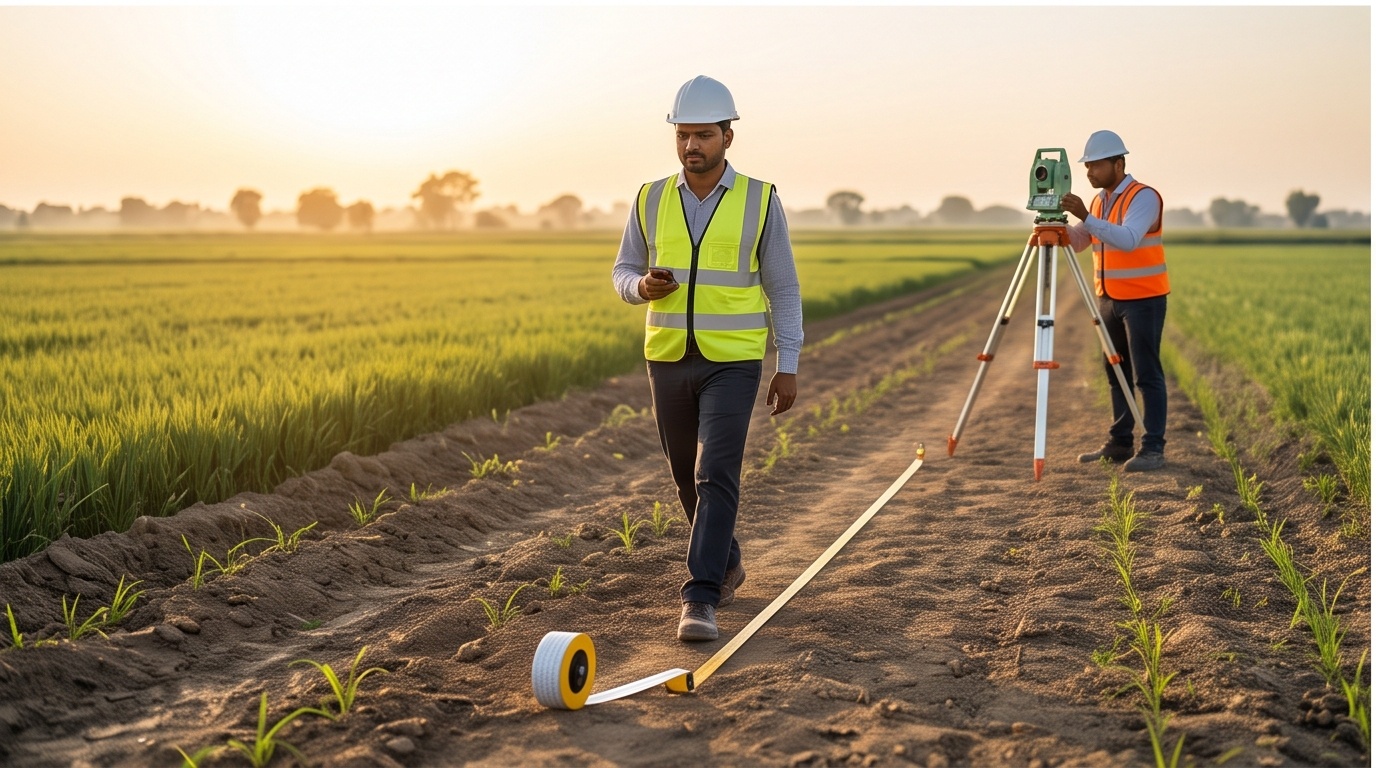
Calibrate Your Pace, Then See Your Distance Measurement Accuracy Gap
1Count Your Steps Over a Known Distance
2Enter the Distance You Walked and Calculate
3See the Error at Any Target Distance
| Method | Accuracy Ratio | % of Distance | Error at 200 m |
|---|---|---|---|
| Pacing | 1:200 | ~0.500% | 1.00 m |
| Tape / Chain | 1:5,000 | ~0.020% | 4.0 cm |
| EDM / Total Station | 1:100,000+ | ~0.001% | 2.0 mm |
Why Pacing Still Earns Its Place in Distance Measurement Accuracy Work
Distance measurement accuracy in the field is a trade-off between speed and tolerance. Pacing, walking a known stride and counting steps, holds to roughly 1:200, about half a metre of error across every hundred metres covered. That is honest, textbook-standard accuracy for a fast reconnaissance walk or an early look at a construction survey site, not for any line a drawing has to hold to.
Tape, Chain, and EDM: Closing the Distance Measurement Accuracy Gap
A steel tape or chain pulled to correct tension tightens that gap to roughly 1:5,000, but sag between supports, thermal expansion on a hot afternoon, and uncorrected slope on rough ground still creep into long chainages. Each small, uncorrected error compounds quietly until a closing check exposes it.
EDM instruments measure distance by timing modulated infrared or laser light reflected off a prism and comparing the returning phase shift, not by counting anything by hand. That phase-comparison method routinely holds better than 1:100,000, several orders of magnitude tighter than either manual method, which is exactly why total stations remain the baseline whenever a stakeout or structural alignment has to meet an engineering tolerance. Walk the calibration above once, and the gap stops being an abstract ratio, it becomes your own metres of error at your own site distance.