Bigha to Acre Converter and Complete Land Unit Guide for India, Nepal and Sri Lanka
One Bigha in Uttar Pradesh is not the same size as one Bigha in Gujarat, Bihar or Rajasthan. This guide, and the free converter tool below, sorts out the confusion in plain language, so you know exactly how much land you are talking about before you buy, sell, or file paperwork.
Try the Free Regional Unit Converter
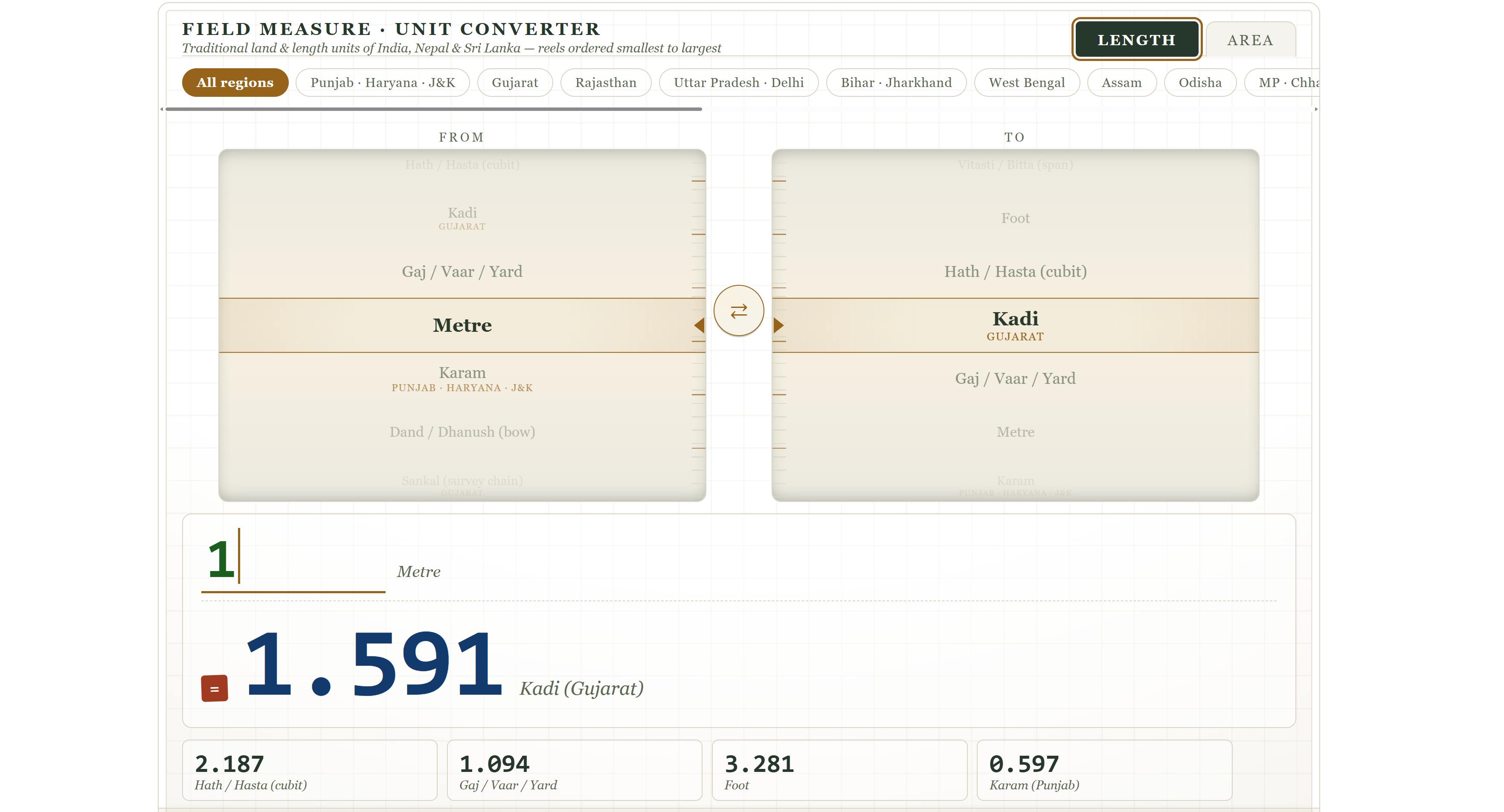
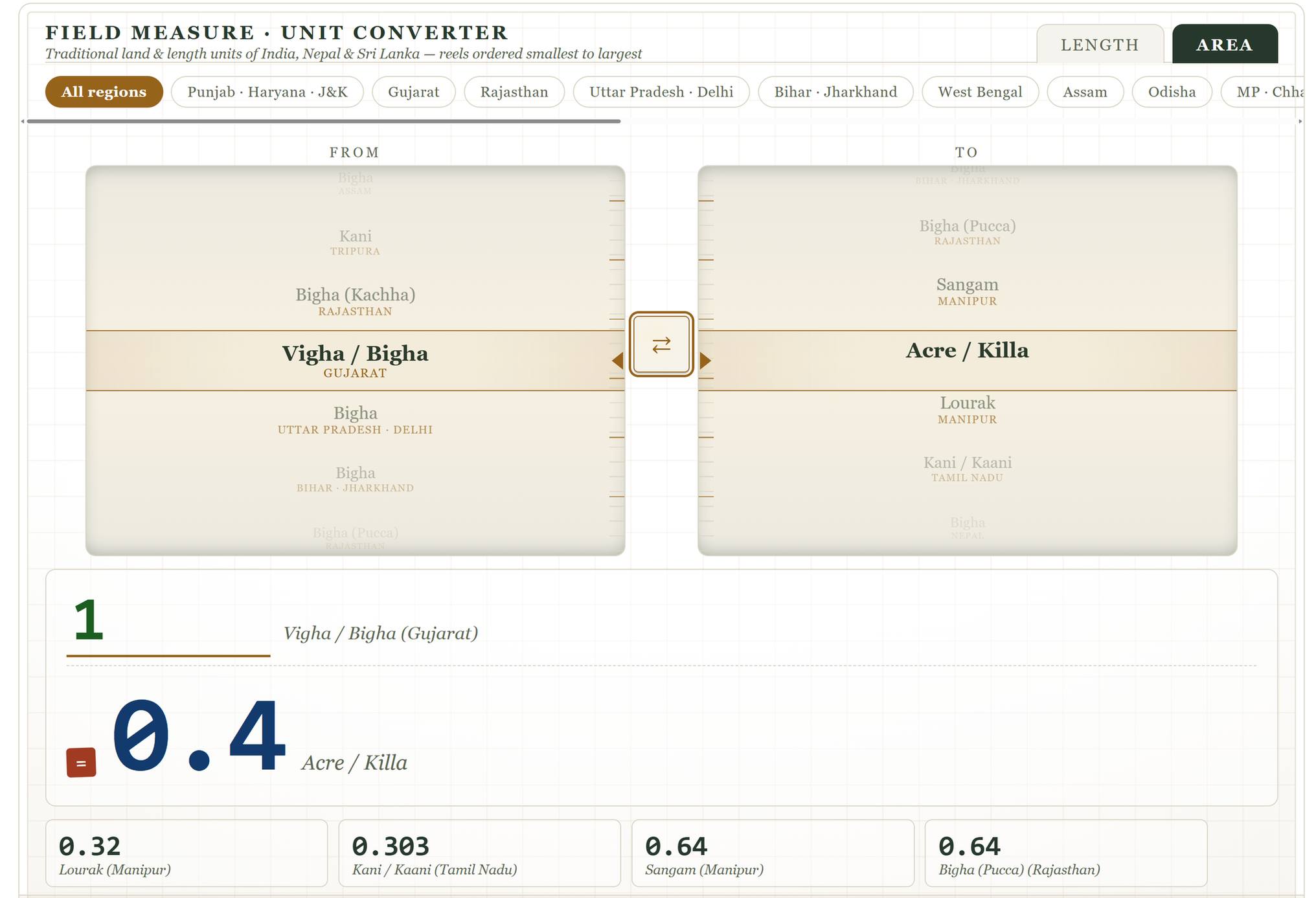
Spin the reels below to convert between Bigha, Acre, Guntha, Katha, Kanal, Marla, Cent and more, filtered by state, plus Nepal and Sri Lanka. Type any value on the built-in keypad and the answer updates instantly.
Field Measure · Unit Converter
Traditional land & length units of India, Nepal & Sri Lanka — reels ordered smallest to largest
Values are commonly used regional standards. For legal transactions, always confirm exact local figures with your state’s Bhulekh, Patta or Jamabandi land records.
Ask a farmer in Meerut how big his field is and he will say Bigha. Ask his cousin in Ahmedabad the same question about a plot of the same actual size, and the number he gives you in Bigha will be completely different. Neither of them is wrong. India never had one single land unit; every region kept its own, often tied to the length of a local rope, a bullock's stride, or a revenue survey done more than a century ago. That is exactly why a reliable Bigha to Acre converter, and a clear reference table, matters more than most people realise until the day they are standing in front of a Tehsildar with a sale deed in hand.
Why Does One Bigha Not Equal Another Bigha?
Before independence, land revenue in India was recorded district by district, often village by village, under local Patwari and Tehsil systems. A Bigha in Punjab was fixed around a Karam, a local rod roughly 5.5 feet long. A Bigha in Gujarat grew out of a completely different Guntha-based grid. Uttar Pradesh, Rajasthan, Bihar and West Bengal each carried their own version forward. Independence did not erase these habits; it simply layered the metric system, the acre, and the hectare on top of units that revenue clerks, farmers and local land offices had already been using for generations.
The result today is a patchwork that a national land unit converter has to respect rather than flatten. A single "1 Bigha = X square metre" answer would be wrong for at least half the country. That is why the tool above lets you filter by region first, then convert, instead of pretending one number fits all.
Field note: Trishunya’s DGPS and drone survey teams run into this mismatch constantly. A client will describe a parcel in Bigha from an old family record, our GPS-based boundary survey returns the area in square metre, and the two numbers only make sense once you know which state's Bigha the original document was using. Getting this conversion right, before construction or sale paperwork begins, avoids disputes later.
Linear Unit Conversion Table (Length to Metre)
Length units matter just as much as area units, especially for boundary lines, road frontage, and canal or drain measurements described in old revenue documents. The table below lists the most commonly used regional length units, converted to the metre.
| Unit | Region / Use | Value in Metre |
|---|---|---|
| Angul (finger-width) | Historical, Vedic unit | 0.019 |
| Vitasti / Bitta (span) | Pan-India, informal | 0.2286 |
| Hath / Hasta (Cubit) | Pan-India, elbow to fingertip | 0.4572 |
| Gaj / Vaar (Yard) | Pan-India standard | 0.9144 |
| Karam | Punjab, Haryana revenue records | 1.6764 |
| Dand / Dhanush (bow) | Pan-India, historical | 1.8288 |
| Sankal (survey chain) | Gujarat | 10.05833 |
| Chain (Gunter’s) | Standard survey unit | 20.1168 |
| Furlong | Standard, = 10 Chain | 201.168 |
| Kos / Krosh | Historical distance unit (approx) | ≈ 3218.68 |
The same table, written as plain text for quick reference and easy copying:
Area Unit Conversion Table (Land Area to Square Metre)
This is where a land unit converter earns its keep. Guntha, Cent, Katha, Kanal, Marla and Bigha are the words most people actually hear at the registrar's office or from a broker, so the table below converts the ten most searched regional area units into square metre.
| Unit | Region / Use | Value in Sq. Metre |
|---|---|---|
| Cent / Decimal / Dismil | East & South India, pan-India | 40.4686 |
| Guntha / Gunta | Maharashtra, Karnataka, AP, Telangana, Gujarat | 101.1720 |
| Marla | Punjab, Haryana, J&K, Ladakh | 25.29285 |
| Katha / Cottah (West Bengal) | West Bengal | 66.8902 |
| Katha / Kattha (Bihar) | Bihar, Jharkhand | 126.4643 |
| Kanal | Punjab, Haryana, J&K | 505.85705 |
| Bigha (West Bengal / Assam) | West Bengal, Assam | 1337.8038 |
| Vigha / Bigha (Gujarat) | Gujarat, Saurashtra standard | 1618.7426 |
| Bigha (Uttar Pradesh) | Uttar Pradesh, Delhi NCR (approx) | ≈ 2508.38 |
| Acre | Standard, pan-India | 4046.8564 |
The same table, written as plain text:
Note on approximate values: Rows marked approx were never fixed by a single central authority. Bigha in Uttar Pradesh, Rajasthan, Himachal Pradesh, Uttarakhand and Madhya Pradesh can still vary by a few percent between districts and even between tehsils. Treat these as reliable working figures, not a substitute for your local Patwari or Jamabandi record when money or a legal document is involved.
Bigha Across States: Why the Same Word Means Different Areas
Bigha is the single most confusing word in Indian land measurement, purely because so many states kept it while quietly attaching a different local value. A buyer moving between states, or an NRI inheriting ancestral land, is the person most likely to get burned by this. Here is how four common versions compare.
Bigha (Uttar Pradesh)
Approximately 2,508 square metre, close to 27,000 square feet. Commonly used across UP and parts of the Delhi NCR property market.
Bigha (Bihar / Jharkhand)
Fixed at 2,528.83 square metre, built from 20 Katha, each Katha further split into 20 Dhur. A cleaner, more standardised system than most.
Bigha (Gujarat)
1,618.74 square metre under the common Saurashtra standard of 16 Guntha, though some north Gujarat districts use 24 to 25 Guntha instead.
Bigha (West Bengal / Assam)
1,337.80 square metre, noticeably smaller than the UP or Bihar version. Always confirm which state's Bigha a document refers to.
A Bigha is not a size. It is a regional agreement about what a size used to be. Something worth remembering before any land deal crosses a state border.
How This Land Unit Converter Helps Farmers and Landowners
Most people do not need a survey report to answer a simple question: how much is my land actually worth compared to a neighbour's plot listed in a different unit. A working Acre to Hectare converter, a Guntha to square feet calculator, or a quick Katha to square metre lookup solves that in seconds, without waiting for an office visit.
Trishunya builds and maintains tools like this one because our own survey teams face the same regional mismatch on almost every land acquisition and topography project we run. A DGPS boundary survey returns coordinates and square metre. A client's old record says Bigha, Katha or Guntha. The gap between the two has to be closed correctly, and closed the same way every time, or the numbers used for compensation, sale value, or construction planning stop lining up.
When You Genuinely Need a Professional Survey
A converter is excellent for quick estimates, comparing listings, or checking a broker's math. It is not a substitute for a certified boundary survey when a dispute, a bank loan, a government acquisition, or a large land parcel is involved. In those cases, a proper land acquisition survey using DGPS or drone-based mapping, tied into a full GIS solutions workflow, gives you a legally defensible area figure rather than a regional estimate.
Nepal and Sri Lanka: Two More Systems Worth Knowing
Nepal runs two parallel systems depending on terrain. In the hill regions around Kathmandu, land is measured in Ropani, built from Aana, Paisa and Daam. One Ropani works out to about 508.72 square metre. In the flat Terai belt bordering India, the Bigha system takes over instead, with 1 Bigha in Nepal equal to roughly 6,772.63 square metre, considerably larger than any Indian state's Bigha.
Sri Lanka keeps things comparatively simple. The Perch, at 25.29285 square metre, happens to be mathematically identical to the Indian Marla, since both come from the same 16.5 foot by 16.5 foot square. Forty Perch make one Rood, and four Rood make one Acre, matching the standard acre used worldwide.
Frequently Asked Questions
It depends entirely on the state. Bigha in Uttar Pradesh is close to 27,000 square feet, in Bihar around 27,220 square feet, in Gujarat about 17,424 square feet, and in West Bengal or Assam roughly 14,400 square feet. Always confirm which state's Bigha you are working with before comparing numbers.
Using the Uttar Pradesh Bigha, 1 Acre works out to approximately 1.613 Bigha. Using the Bihar Bigha, it is closer to 1.6 Bigha. The exact figure shifts slightly depending on which regional Bigha value you apply, since 1 Acre itself is fixed at 4,046.8564 square metre everywhere.
1 Guntha equals 101.1720 square metre, which is 1,089 square feet. It is the standard subdivision used across Maharashtra, Karnataka, Andhra Pradesh, Telangana, Gujarat, Goa and Odisha, and 40 Guntha make 1 Acre.
This changes by state. A Katha in Bihar or Jharkhand is 1,361.25 square feet, while a Katha in West Bengal is only 720 square feet, roughly half the size. Nepal's Katha, part of its Terai Bigha system, is larger still at 3,645 square feet.
1 Acre equals 0.4047 Hectare, and 1 Hectare equals approximately 2.471 Acre. Both are internationally standardised units, so unlike Bigha or Katha, this conversion never varies by region.
20 Marla make 1 Kanal in the Punjab, Haryana, Jammu and Kashmir revenue system. 1 Kanal equals 505.857 square metre, and 8 Kanal together make up 1 Killa, which is the local name for 1 Acre in this system.
Rajasthan uses two Bigha values side by side. Pucca Bigha is the larger figure, around 2,529.29 square metre, while Kachha Bigha is smaller, around 1,618.74 square metre, the same value as the Gujarat Vigha. Land documents in Rajasthan should always specify which one applies.
Nepal uses two separate systems. The hill and Kathmandu Valley region measures land in Ropani, built up from Aana, Paisa and Daam, where 1 Ropani equals about 508.72 square metre. The flat Terai region instead uses a Bigha system similar to North India's, with 1 Bigha equal to roughly 6,772.63 square metre.
1 Perch in Sri Lanka equals 25.29285 square metre, identical in size to the Indian Marla, since both are based on a 16.5 foot square. 40 Perch make 1 Rood, and 160 Perch, or 4 Rood, make 1 Acre.
Most regional land units were never fixed by a single national law. They grew out of local revenue surveys carried out district by district, sometimes tehsil by tehsil, long before independence. Rajasthan, Uttar Pradesh, Madhya Pradesh and Himachal Pradesh all still carry small regional variations in their Bigha figure for exactly this reason.
Use it for quick estimates, comparing listings, or checking rough math before a meeting. For an actual sale deed, bank loan, court matter, or government acquisition, confirm the exact figure with your local Patwari, Tehsil office, or a certified land survey, since local records take precedence over commonly cited regional standards.
Yes. Alongside Bigha, Acre, Guntha, Katha and other area units, the converter also handles length units such as Gaj, Karam, Hath, Chain, Furlong and Kos, converting each to the standard metre so you can check boundary lines and frontage measurements too.
Land measurement in India was never designed to be simple, and pretending otherwise does not help anyone standing at a registrar's desk with two different numbers in hand. What helps is knowing which regional unit you are dealing with, converting it correctly the first time, and getting a proper survey done whenever the number actually matters. Use the converter above for the quick math, and reach out to Trishunya's survey team whenever a parcel of land needs to be measured, not estimated.